
2,545 problem-gambling calls were made in 2025 to NY State’s HOPEline. This represents an 8.5% increase in calls between 2020 and 2025 according to a recent report released by NY State Comptroller Thomas P. DiNapoli.
But that number doesn’t tell the whole story.
You and I both know that for every person that calls and asks for help, there are tens, hundreds, or thousands struggling with an issue that they may or may not realize is problematic.
The table below comes from this report and it shows where the growth has come from in the past few years: mobile sports betting. Since 2022, mobile sports betting has seen a year-over-year increase in revenue for NY state that has increased to $1,300 million dollars in 2026. Which is equal to $1.3 B for those doing the math at home. That makes mobile sports betting the second-largest source of gaming revenue, trailing only the lottery.
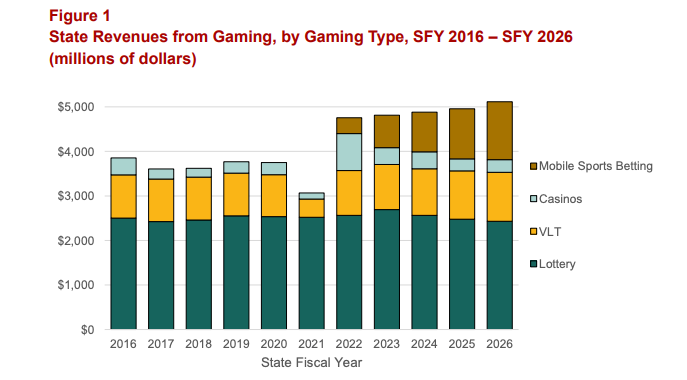
And the data didn’t even include fantasy sports betting which averaged an additional $20.4 million annually over the period of the analysis. But that’s a drop in the $1B bucket that sports betting has made in 2026 – and we aren’t done with the year yet.
More Betting Is Not a Good Sign
When it comes to addiction in this country, we don’t really do much. If we even speak about it, we are usually throwing platitudes in its direction without ever really addressing the underlying causes. Usually that is because there are intricate systemic and social factors that are hard to control that are associated with increased risks of addiction.
This expansion in sports betting has had a clear connection with the rise in calls to the gambling addiction lines. And the beauty of that is that there are some easy ways that we could make it more difficult for people to become addicted to gambling to begin with. The lowest hanging fruit on this one is to regulate the extreme amount of advertising that has embedded itself into every aspect of sports coverage in just a few short years.
It wouldn’t be the first industry to get a marketing overhaul either. Ads for cigarettes and nicotine containing products have been heavily regulated, even if they weren’t initially. That’s because we have an understanding of how marketers harness the powers of social psychology to persuade us to behave in a certain way. But when it comes to sports betting, we don’t seem to have given it much thought, maybe we should start.
And with $1.3B in revenue for the state from mobile sports betting, the meager $6 million increase in funding for problem gambling services is not enough to address the harm that these companies, and the states they operate in, are causing. Particularly when compared to the amount they have financially benefitted.
Gambling isn’t Just a Good Time
Generational levels of wealth have been wiped out with gambling. Whether at the craps table or on the parlay for the big game, the damage on the other end is the same. Families suffer when they have someone addicted to anything, gambling is no exception.
In recent years, with the explosion of online gambling platforms, a million new opportunities have been created for addiction to get its meat hooks into people. Too little has been done to protect people from the worst consequences of sports betting. The hotline in NY state being one of the Band-Aids thrown in the direction of the bullet wound that is being repeatedly opened.
Our Sons Are at High Risk
Belonging for a young man is often intertwined with sports. The ones he plays. The ones he watches. The teams he roots for all matter. As early as elementary school, kids are watching the same sports streams that adults are. And today, they are marinating in a culture that glorifies gambling like we have never seen in our lifetimes.
I can’t remember a single moment of sports betting even being discussed during the games as a kid. Partly because I’m sure I wouldn’t have really understood what they were talking about, maybe they mentioned the over/under on the game, but either way, it was lost on me at the time.
Today, who could possibly miss the gambling ads if you watch any duration of an MLB, NFL, or NBA game? Regardless of how old the viewer is, there are banners across the bottom of the screen, mentions of the odds and where to bet, commercials interjected, and commentators sliding in more commentary about betting throughout the broadcast.
Even though female viewership of the NFL has been increasing, males still represent a greater percentage of the fan base for the major sports than their female counterparts with some sources citing about a 60:40 (M:F) split. But our daughters don’t struggle as much with risk seeking behavior as our sons. As anyone who has paid for car insurance as a new driver knows that even the insurance companies are betting on our boys taking unnecessary risks that end up reflected in higher premiums. And as a mom of two boys, I worry about how this messaging around gambling is going to impact them over their lifetimes.
Massachusetts has already seen a quadrupling of children with gambling problems in the last 4 years. With 4-5% of youth ages 12-17 struggling with problem gambling compared to just 1% of adults. That means that 40,000 adolescents in Massachusetts struggle with gambling. The analogous data for adolescents in New York was not present in DiNapoli’s study, but I’m sure the data would be similar if we had it.
Starting Them Young Isn’t a Solution Either
When my son asked about us getting him a FanDuel account at the ripe old age of 12, I struggled to wrap my brain around the request. We are not gamblers, although Brian always seemed to bring home more money than he left with if he was going to Atlantic City, but he hasn’t even gone since the boys were born.
He supported his ask with a mention of a friend who has their own account that they get a budget on and how his friend is getting ‘taught how to bet responsibly’. In his teenage brain, it felt like the right angle. Can’t blame a guy for trying, but seriously, how is that teaching ‘responsibility’?
I explained to both our boys how addiction to gambling can ruin lives. We actually have cousins who lost so much due to their dad’s gambling problem. The trajectory of their lives was irrevocably impacted with ripples that spanned decades beyond the bets. I was lucky enough to hear about this when I was a kid and I think it inoculated me against some of the thrill of gambling. I hope that it will do the same for our boys, but could it possibly be enough to combat the constant marketing being tossed at them from every platform and direction? Could it outweigh the peer pressure to place bets? Sadly, only time will tell there.
My son’s friend is clearly not the only one with such an account, as it showed up in the data out of DiNapoli’s office too. The report cites an increase from 54 to 1,972 “alleged incidences of underage participation in mobile sports wagering accounts” which it says occurred when underage users were granted access to “lawfully established accounts”. In other words: their parents or another legal adult set up an account in their own name and allowed it to be used by someone underage.
But this increase makes sense when you remember that after 2020, online sports betting platforms started expanding and proliferating. The online platforms can only do so much to ensure they are being used by adults before they run right into creepy privacy violations. There was more ability to control who was placing bets when they needed to be made in person, but I’m certain that plenty of underage individuals still gambled by getting someone of age to place the bet for them too. It was just more work for everyone involved. And maybe that wasn’t such a bad thing.
Why This Really Matters
Gambling addiction has one of the highest suicide rates of all addictions, with one in five people struggling with gambling disorder attempting suicide at some point. Which makes sense when you think of the crippling impacts that ‘losing it all’ can have on someone’s economic circumstances. And too often, gamblers will try to dig themselves out of the hole they find themselves in with the same shovel that got them there – more betting. With increasingly risky people on bets that are increasingly less likely to materialize into the solution they need. The shame of being in this position is poison.
If our kids are raised around a culture that normalizes and glorifies sports gambling the way we currently do, how can we expect them to have a healthy sense of the dangers associated with the habit? Even the “problematic gambling? Call….” at the end of the ad isn’t enough. How do they even know if they fall into that category? Where is the education that helps them to know when they are in hot water? Without that education, it’s irresponsible for us to continue to allow these platforms to carry on with business as usual.
The youngest among us aren’t immune to gambling addiction either. According to mass.gov, gambling disorders can begin in children as young as 10 years old. Early exposures to gambling are not innocuous. A child that is allowed to bet before the age of 12 is 4 times as likely to have gambling problems later in life. Which shouldn’t surprise any of us. The same can be said for most addictions, alcohol included. Delaying exposure is a protective factor, the same way it is with alcohol.
For anyone who has debated whether or not to ‘help their kid to learn responsible betting’, I implore you to hold off until they are legally allowed to do it. You can still help support them at that point, but there is nothing good that is going to come out of them gambling any earlier.
If This Sounds Familiar
If any of this is landing close to home, whether for you, your kid, or someone you love, here’s what to look for and where to go.
Signs worth paying attention to include betting more money than intended, chasing losses by continuing to bet after a loss, feeling anxious or irritable when not betting, hiding losses or borrowing money to cover them, and neglecting work, school, or family responsibilities to keep betting.
You can read a full breakdown of the signs, risks, and treatment options from Lindner Center of Hope here.
If you or someone you know is struggling, New York’s HOPEline is available 24/7 at 1-877-8-HOPENY, or you can text HOPENY (467369).
This isn’t about shame. It’s about catching it early enough to make a difference.