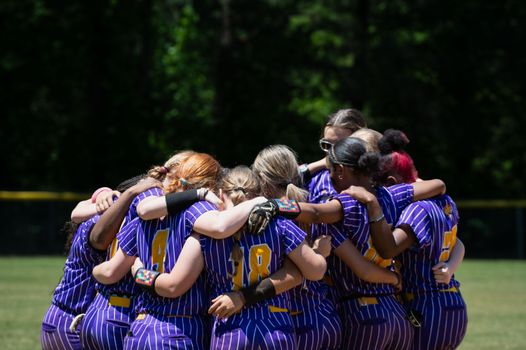
For every chant in a softball dugout, there is at least one player who wishes she could be somewhere that she could be taken seriously. Somewhere that she didn’t have to wear a literal mask just to play in the infield because the only thing that the adults around her making decisions seem to be worried about is her perceived value through her beauty.
Even in 2026, young girls are still often treated like their ticket to success is through meeting Mr. Right.
The masks on softball players are just one of many examples of this.
Hot take: anyone who doesn’t want to have to pitch underhand with a giant ball with a mask on their face should be allowed to play baseball. After all, if we really are getting an official Women’s Professional Baseball League, then we had better be figuring out how to create a pipeline to get there.
Our road to The Show, if you will.
Technology Makes Exclusion Easier
This is definitely not the default setting in most towns across America though. Most towns preplan who will be offered what sports as options when building out their online check outs. Technology has made exclusion even easier.
And they don’t even need to ask you the gender of your child every year. You just need to provide it once and then with a click of a button, baseball gets gate kept from our daughters.
I’m not talking about softball being lesser. I’m talking about the choice being taken away before it was ever offered to those that might want to continue pursuing baseball.
The amount of friction you would have to go through to get your daughter signed up for baseball is more than the vast majority of people are willing to go through. Most of us don’t want to create waves, we just want our kids to stay active, learn some life lessons through sport, and to build community.
Who Wants to Have to Force Their Way In?
Being the only anything anywhere is not an easy situation to be in. Being the only girl on the baseball team is no different. And considering the ages that we separate players at in most small towns, it’s at an age where being the only girl in a group of boys starts too many people’s minds down the wrong path. Then the rumor mill starts and motivations get questioned. How many folks even be willing to tolerate what their whole family would go through after signing up their daughter for baseball?
I’m going to go out on a limb and say: not many.
Which is accurate if you look at current participation rates for girls in baseball. Baseball for All cites over 100,000 girls play youth baseball in the US. That is clearly a drop in the bucket compared to the tens of millions of baseball players total in the country.
Statistics from Project Play make the story even clearer. In children aged 13-17, baseball had an 8.7% participation rate in 2024. Softball has a meager 1.7% participation rate in comparison. If the assumption is that all 8.7% of baseball players are male, then it seems like boys are playing more than 4x as much ball as their female counterparts. That can’t just be because the girls “lost interest” or “grew out of” their love for the game.
We All Start with Baseball
Most towns are similar in the way they do Tee Ball. Every kid who signs up is split up amongst the teams regardless of gender and then hilarity ensues. Herds of children follow the baseball across the field like they are playing soccer. Bases are abandoned and no one has any idea where to throw the ball. Although, there’s usually one player on every team that should be playing up, I talk more about that here.
But you know what I’m talking about. Baseball is totally fine for girls…until it isn’t.
Somewhere around 8 years old, girls will be transitioned abruptly to softball.
What a dramatic shift it was to watch as the girls shuffled off to softball and started to lose interest at the very same time that the boys were getting more serious as they dove further into baseball.
It wasn’t easy to watch as a coach. Great players with natural talent and a drive to do well suddenly found the dugout chants more important to their team mates than what was happening on the field. Some stopped playing altogether.
Nothing had changed in the player; it was clearly a systemic issue. At least, that’s how I see it. Although, that didn’t seem to be on anyone else’s radar. They just seemed to think it was normal that even the best ball players would check out once they were on their all-girls softball team.
We Have to Stop Blaming the Victim
That dismissal of any factors outside of the girls is victim blaming at its finest. None of the parents of those players or coaches that I spoke to seemed to think it was anything other than the girls “growing up”. They chalked it up to a “natural” progression.
I disagree categorically. There is nothing natural about losing interest in something you once loved. Girls aren’t “growing out of” their love for baseball. Baseball is being systematically taken from them. And their passion for the game can be taken right along with it.
This got me to start questioning why the shift was happening.
Did they feel “othered” by being forced out of baseball? An easy moment for this to happen is when they are told they need to wear masks in the infield for the first time ever. Which is an interesting choice considering many were playing with boys just the year before. But surely, they feel that the adults around them are trying to protect their “pretty little faces” as someone once put it.
When the priority for them is focused on maintaining their looks, can that send the wrong message about their athleticism? Does it tell them that people don’t trust that they can learn to protect their faces with their gloves?
Do the boys make fun of them for needing them? Or is there something I’m missing like less skilled coaches? I struggle to believe that to be true, but perhaps there is something that could be teased out to understand coaching quality and culture on the teams and how they differ from the baseball teams.
I didn’t play tee-ball. I started playing softball around 8. So, I don’t have a first-hand experience of this as a player. But these questions are important ones for us to explore if we want to get to the actual root cause for the apathy that many girls show as they are forced into softball. Kids are the truth man; they will reflect back to you what they are receiving. And changes in them are usually created by their environments, so it’s important to look there first.
If those players are checked out, it’s because they can tell that they adults are too.
The structure sets the stage. The culture plays it out.
Masks Are Only the Beginning
I have had a few opportunities to listen to softball getting coached behind us while sitting and watching one of our boys play baseball over the past few years and even just getting small snippets of the coaching tells me so much of why the girls are disengaged.
Shockingly, most of the coaches for softball are still men. Which should shock anyone who is paying enough attention. When did they play softball? What are they basing their credentials off of? Baseball? Cool, so I hope you won’t mind me saying that women belong coaching baseball too for the same reasons, right?
But the coaching creates the chanting that so few of us are fans of. The repeated refrains of “cheer for your team girls” and “I can’t hear you out there ladies” are not helping players to know what to say or how to cheer on their teams better. So, we end up with “Bang, Bang, Choo Choo Train…” and other nonsense that keeps them focused on something other than talking to each other.
And I get it, when you are trying to keep a team focused on a game, you are definitely going to need to remind them more than once. Especially for younger kids. I’m not saying that reminders aren’t important. But modeling is way more important.
Modeling Expectations as Coaches
As coaches, we need to model our expectations for our teams. Being specific with support and reminders, clapping, “atta babe”, “let’s go”, “you’ve got this”, are all great starts, but talking directly to your team at some point before the first game is a great idea too. Especially for younger players.
If I could do 8U over again, I would take a few minutes during a practice just to talk about what support and encouragement looks like. And show them the difference between trying to coach their fellow team mate and just being an awesome support. Because you can’t expect your team to do anything that you haven’t practiced, cheering on their team mates included. And we can’t assume that they are getting this from their parents either. Many are not watching baseball at home and those that are may not be setting the best example when screaming at a box on the wall.
Putting Kids on the Spot Sucks – Just Don’t Do It
Recently, I overheard a softball coach putting a kid on the spot to ask how many outs there were in that inning after seeing that she clearly had been talking to a friend on the bench. When she got it right, the coach wasn’t thrilled and wasn’t going to let her off the hook. He fired back that she just “got lucky”. Gosh I’m sure that kid felt great about herself that day. How big do you think that coach felt in comparison? 10 feet tall or so?
Our job as coaches is to help players fall in love with the game and to learn it. That isn’t going to look the same every day. But I can tell you that shame will never belong anywhere in that equation.
Shame will not create habit change in a player. Unless you mean the habit of coming to practices and games. That coach was no better than an adolescent in that moment. Incapable of identifying what was really important because his feelings were in the way. By putting the player on the spot, he publicly lost when she got the answer right. Regardless of how she knew the right answer, he now had egg on his face.
That likely made his back feel like it was against the wall. But it didn’t have to be like that. He could have avoided the whole thing by discreetly saying something to her with a focus on the paying attention part without the pop-quiz. Then he doesn’t have to get up in his feelings from the public showdown.
And while this could happen on any team to any player by any gender coach, it’s sadly so much more prevalent in softball dugouts where girls have been systematically painted as not caring. This creates a built-in excuse to the lashing out that coaches feel is necessary.
To be clear, it’s not. It’s never necessary to lash out at a child, coach. If you disagree, this is the wrong place for you. There’s plenty of bro-coaches for you to hang around with. This isn’t a safe harbor for that type of disrespect.
Every one of your players is a person. Who deserves love and respect. Period.
The respectful thing for us to do for our daughters is to reconsider this whole XX = softball and XY = baseball equation. Right now, there aren’t many places that are doing that. We are building one that does just that. And we aren’t alone. Organizations like Baseball For All exist and they are helping to connect girls to baseball right now. So, you know we had to share them with you.
If you’re a softball player, parent, or coach, what do you think? Am I on to something with any of these questions? Or did I miss something? Sound off in the comments.
And if you’re fem presenting and would rather be playing baseball, welcome home. I’m glad you’re here. Consider subscribing to our newsletter for updates on our leagues as they develop.
With gratitude,