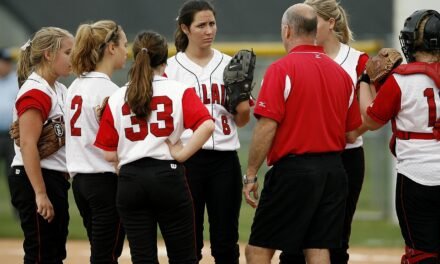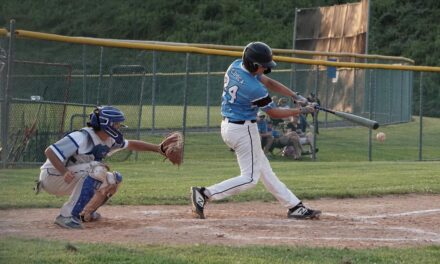
Picture three players on the same team, on the same Friday night.
Mason takes the mound in the second inning and walks four batters in a row. His coach walks out, tells him to breathe, tells him to trust his stuff, and heads back to the dugout.
Layla is playing shortstop. She boots two routine ground balls, the kind she has fielded a thousand times. Her coach calls out from the dugout, “Focus, Layla. Watch the ball into the glove.”
Maclain is at the plate, swinging at everything in the dirt. Pitch after pitch, low and away, and he goes after it. Coach calls time, pulls him aside, and reminds him to punch through the ball and get his hips into it.
These three players are composites. I’ve spent more than 25 years working in sport around the world, from Division I athletics through four Olympic Games, supporting athletes for three countries. I’ve stood behind the backstop and in the dugout, and I’ve stood on the sides of pool decks, soccer fields, rugby pitches, basketball and volleyball courts, and tracks. Baseball players look different from rugby players, but the pattern doesn’t change. In sports I’ve been a part of, I’ve watched something present as one problem when it was really something else.
What if the real story behind those three players was more like this?
What if Mason slept about five hours last night, woke up late, and didn’t have time to make his lunch? He walked into the Friday night game with almost no fuel in the tank. His arm is fine and his head is fine. An empty tank makes a kid look anxious, shaky, and out of rhythm. That would be an Energy problem dressed up as a Mind problem.
What if Layla just went through a growth spurt? Her energy needs have changed, and her routine hasn’t caught up. She’s taller than she is strong, so her first step comes a hair late, and her feet aren’t organized when the ball arrives. Focus has nothing to do with it. That would be a Body problem, and Layla’s parents might not have the funds to hire a performance coach to help her build the athleticism and body strength that fit what she needs based on how she moves.
What if Maclain walked into the ballpark carrying something from school that day? A comment from a classmate, a test he thinks he bombed, a friend who stopped talking to him. His mind is somewhere else, so his eyes are somewhere else, and he chases everything. His coach corrects the things he sees, technique, but that was never the issue. This one really would be more of a Mind opportunity.
Three kids. Three different possible causes. Coaches aren’t careless. They just don’t have the time to check in with every player before every practice or game.
Readiness is one state made of three parts
The question that separates good support from average support is simple. What is really going on with this person today?
Mind, Body, and Energy each matter on their own. A kid who lacks confidence needs help building it. A kid who isn’t physically prepared needs to build strength relative to their size. A kid who hasn’t eaten needs food.
However, Mind, Body, and Energy aren’t silos. They’re integrated, and together they add up to one state. That state is readiness. Energy sits underneath the other two. When a kid is short on sleep, water, or fuel, their confidence can drop, their strength can wane, and their movement can get sloppy. From the sideline, the symptoms look like a concentration problem or a physical development problem. Energy fuels both the mind and the body, so the root cause often sits downstream of what we see. As parents and coaches, we react to the symptom because we can’t see the cause.
That’s why I get wary of the phrase “they’re just having an off day.” Sometimes they might be. Most of the time it is something that can be corrected and developed if we knew what it was and if the child knew what to do when they were experiencing it. You can’t know until you have the right information, and what gets measured gets managed.
The incubator of evaluation
Here’s the part I think we underestimate as adults. Kids live inside a constant stream of evaluation. Teachers grade them. Coaches watch them. Teammates compare them. Parents, with the best intentions, ask how they did before the car door was even closed. Minute to minute, hour to hour, day to day, someone is measuring them.
Adults experience evaluation everywhere too, but we’ve figured out ways to handle it. Some of those ways aren’t as good for us as they should be. The good ones are the mindful practices, the physical training that lets our bodies support our minds, and the food that takes care of us. Plenty of adults don’t know these tools exist, yet they still have the autonomy to go find them. Most kids don’t. The expectation follows them everywhere, and the adults around them have no real way to see how the child is coping.
We have to do something about how ready our kids are for sport, school, and life, and a good first step is to know how ready they are for evaluation and how informed the adults in their life are to coach, evaluate, or praise.
I’ve helped Olympians understand that we get ready by doing small things every day that turn evaluation into a welcome friend. When a kid has slept, eaten, and is as strong as they are big, the game, the test, or the hard conversation with a friend, stops feeling like a threat. It becomes confirmation of the ready habits and wins they have stacked. That’s growth and development.
Our kids need stress, because stress creates change. But it has to be stress at their level, and they need the tools to manage it and turn the stress into success.
Kids don’t show up magically ready
Many of us treat youth sport like a drop-off service. We bring our kids to the field, hand them over, and expect an experience to happen with them. But all too often, it happens to them instead.
What we tend to miss is the cumulative effect. The bad sleep on Tuesday, the rushed breakfast on Wednesday, the stress that sat in a kid’s chest all week. Those stack up. By Friday, that pile is what walks onto the field.
If we aren’t giving kids the tools to understand themselves, and the chance to stack small personal wins that turn into better self-care, we are counting on hope performance. Hope performance is expecting a good result from work you haven’t done. It looks like practicing a couple of times a week, showing up at the game, and hoping it goes well. Skill and physical ability are rarely the limiting factor on game day. Where a kid’s mind, body, and energy sit that day usually decides it.
Known performance is what a kid brings when the work in and around practice has already been done, so they are ready for whatever comes, whether that’s a game, a practice, a test, or a hard day. The result belongs to them, win or lose, because they know what they did to get there and what they skipped. They can be proud of it, keep doing what worked, and target what didn’t. Hope performance leaves a kid guessing. Known performance gives them something to build from.
Over my career and with my own kids, I’ve seen that those who put their eggs in the known performance basket and let hope carry very little of the load have more success. Stacking Mind, Body, and Energy habits every day, in and around training and competition, builds the confidence to perform with certainty. After more than 40 medal campaigns, I’ve learned that if your Mind, Body, and Energy habits aren’t confirmed and well-practiced the Tuesday before the Olympic final, you have very little chance of being successful on game day. An Olympic medal reflects deliberate practice and the personal wins in Mind, Body, and Energy that support who you are and who you want to be, as a person and as an athlete.
Three questions
Try asking these questions to your young one and listen without trying to fix anything.
How did you sleep, and what have you eaten today? (Energy)
How does your body feel when you move? Any spots that feel tight, heavy, or off? (Body)
How was your focus out there? (Mind)
Their answers won’t always be tidy, and that’s fine. Kids who get asked these questions regularly start asking them of themselves, and that self-awareness is the tool. Over a season, you and your player will start to see patterns nobody could have caught from the dugout.
If you’d like that daily check-in to be something you can measure and inform a mind, body, and energy program, that is built by experts who understand youth development, and something you and your child can learn and do together, check out Ready First at youthreadyfirst.com/launch.
Dr. Matt Kritz, PhD, CSCS, is the founder of The Ready Collective, whose product, Ready First, is a youth development system for ages nine and up built by a team of experts. He has spent more than 25 years supporting athletes across elite sport on three continents and is the author of The ART of READY.
Full transparency: nobody paid Strike Sports to feature Ready First. We’re not receiving a commission or kickback of any kind. We’ve connected with the team behind it because the philosophy lines up with how we think about athlete development.