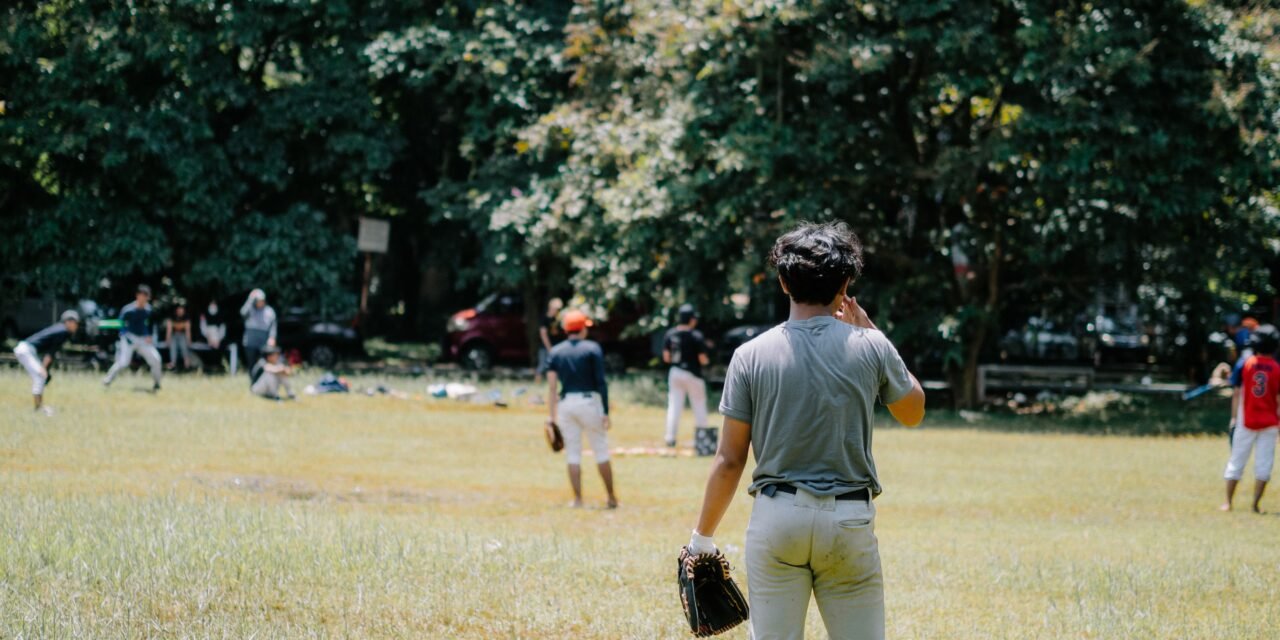
I was in second grade and decided to play baseball for the first time ever on my church team. It was blazing hot. It was boring. On top of that, my baseball coach spent the entire season telling us how bad we were. From that point on I said that I hated baseball. I never played organized baseball again. Not in third grade, not in middle school, not ever.
Camden had a similar experience in second grade, but I’ll tell you about him later.
I’m not alone
On average, kids stop playing organized baseball at 10.5 years old, after about three and a half seasons. That’s from the Aspen Institute’s 2019 Project Play survey. While basketball holds kids until 11.2, baseball loses them earlier than almost any other sport on the chart.
An Associated Press and Ipsos poll released in August asked parents whose child had quit an organized sport why it happened. Four of the five reasons they gave describe the experience.
Of parents whose children had quit, eighty-six percent said their kid lost interest. Fifty-one percent said the kid did not feel good enough to keep playing. Forty percent cited too much pressure to perform. Twenty-six percent cited bullying or other negative behavior. And forty-one percent cited cost as a reason.
Nobody said their kid stopped liking baseball. They said their kid stopped liking what happened at baseball. In other words, the experience of baseball itself.
We only study the kids who play the game
Parents whose kid played from T-ball through senior year likely say, “well my kid played and loved it.” That’s wonderful, but your kid’s good experience is not evidence the system works. It’s evidence that your kid survived it.
In World War II, the Allies examined bombers returning from missions and mapped where they had taken fire. Wings, tail, fuselage were the most common places they had been hit. To keep pilots safe, they reasoned incorrectly to armor those places.
Until a statistician named Abraham Wald pointed out a flaw in this logic. Those planes made it back. The holes they came home with were the survivable ones. The armor belonged where the returning planes had no holes at all, because the planes hit there were at the bottom of the English Channel.
We’re doing the same thing today, youth baseball concentrates on the “returning planes,” not the kids who are leaving the sport.
Our coaching clinics, our development curricula, our showcase circuits, our ideas about what works are all built from watching kids who are still playing at sixteen. Those are the kids in front of us. The ones who survived.
The ones who left the sport at an early age, because of the experience, are not in the dugout. They aren’t learning life lessons that baseball teaches anymore. They aren’t buying gloves, bats or paying for private lessons anymore. They aren’t with their friends having fun anymore.
This is why nothing gets fixed. We keep asking why those kids were not good enough. We never ask what the game did to them before they had a chance to be.
Nobody designed anything to keep them around longer and so they just go away.
Start. Like. Love.
Robert Vallerand, a psychologist at the University of Quebec in Montreal, spent a career on what he calls the Dualistic Model of Passion. The short version is that passion isn’t something you have. It’s something that develops, in stages, under specific conditions. You start. If the early experience gives you enough positive signal, you come to like it. Keep going under the right conditions and it becomes part of who you are.
Start. Like. Love.
Most kids who leave baseball never get past Start. Which means they never reach Like, so Love never gets a chance.
And that’s not a mystery. The conditions Vallerand describes as necessary are the exact conditions a traditional youth game fails to provide. Somebody who is glad you are there. Belonging before performance. Enough repetitions to feel competent. Grace to still learn this incredibly difficult game.
Think about being 10 years old in right field in the fourth inning after sitting on the bench and striking out last inning.
Looking back, knowing now how great baseball is, I’m disappointed I was never given a chance to Like the game. I got stuck at Start.
You know it’s true
We now have access to more data than ever before thanks to GameChanger®. I’ve logged my daughter’s and son’s games for years as well as for the teams I’ve coached. This is not published research, just stats that I’ve collected and am sharing here with that disclaimer (I bet your own records will verify my results).
In a traditional baseball game for kids aged 9 to 12, a kid averages 1.3 plate appearances in a 90-minute game (max 6 innings). About a quarter of all plate appearances end with a ball in play. The rest end in walks, strikeouts, dropped third strikes, and hit batters. Add in errors and stolen bases and that is most of the scoring.
The average kid puts a ball in play about once every three games. On defense, about two out of three kids go a whole game without one ball hit to them. Not one chance to try to make a play.
Then we wonder why a ten-year-old says he “hates baseball” and would rather play a sport that allows him to run up and down a field or a court regardless of whether or not he has the ball.
Let’s fortify the plane so more kids get from Start to Like
I’m an entrepreneur. I see things that aren’t working and ask, “Wouldn’t it be great if _____?” and then get to work building a solution.
“Wouldn’t it be great if more kids learned to love this great game in a format that is action-packed and development rich while having a great time?” That’s the question that led me to create 5-Pitch Plucky.
80 minutes start to finish. Every kid bats every inning. Five pitches to put the ball in play. Defense rotates through every position every second batter. No walks. No steals. One coach/umpire/cheerleader. No obnoxious parents. No parents yelling through the fence, no bad umpire calls or coaches arguing on the field.
Earlier this Fall, even with twenty kids playing, every kid got 4 plate appearances. 72% percent of those at-bats ended with a ball in play, which means a ball was hit somewhere roughly every 90 seconds.
Work that through the same way. The average kid put a ball in play almost three times that night instead of once every three games. On defense, 19 out of 20 kids had a ball hit to them, instead of two out of three going home without one.
Remember, 86% of parents said their kid lost interest. That’s what the rotation is for. Nothing stays the same long enough to get boring, and every at-bat is over within five pitches.
Same field. Same ball. Same bat and glove. Way more reps. Eighty minutes of action and fun for every player.
It’s the experience, not the game
Rotating positions isn’t a new idea. Batting the whole roster isn’t a new idea. What I did was stop treating the experience as fixed and asked what could change to get more kids into the game and keep them there.
Going back to that AP/Ipsos poll. “Lost interest.” “Didn’t feel good enough.” “Pressure to perform.” “Bullying.” Other than cost, these four reasons describe the experience of playing being broken.
Kids are asked to prove they belong before anyone lets them, handed too few reps to get good at anything, taught to see teammates and opponents as competition rather than company, coached through correction instead of encouragement, and measured only by outcomes they barely got the chance to produce.
This is where I focused. On the experience. That is why I focused on improving the experience.
5-Pitch Plucky is designed to remove all of the reasons why kids don’t get past Start. From how teams are formed, to having only one adult on the field coaching and umpiring, to providing the opportunities to develop each player on-field in real time. And for those who coach, in this environment, parents step back and let the kids enjoy because they can see how much fun their players are having without all the extra drama that can come with traditional leagues.
The kid we almost lost in battle
Getting back to Camden. Like me, Camden’s bad experience with baseball in second grade made him think he hated the game and vowed to never play again. When Camden was in 8th grade, his parents coaxed him into trying 5-Pitch Plucky after hearing about it through the local rec league.
Camden is now playing for his high school team. His dad texted me recently attaching a video of Camden on the pitcher’s mound. He wrote, “Camden pitched for the first time in a game on Tuesday. He did well. 3 innings. 4 Ks. 2 runs. Thanks for being part of his journey!”
A different experience progressed Camden’s path from Start to Like to Love. We’ll see where he goes from here. College? MLB? Who knows? That’s not the point. He now loves baseball and is a fan of the game. We won the battle for Camden by simply reimagining the experience from Start to Like to Love, not by changing the game.
And just in case you were wondering, it’s not too late for adults either. They too can experience the joy of baseball playing 5-Pitch Plucky but I’ll save that for another day.
What are you willing to change?
Sure, I’d love for you to reach out and learn more about 5-Pitch Plucky. But that’s not why I wrote this.
If you coach, take an honest look at the experience you’re creating and ask whether your ballplayers will come back next season. If you’re a parent, find out where your kid is on the path from Start to Like to Love. And if Love ever turns back to Like, my guess is it won’t be the game that did it. It’ll be the experience.
I never got past Start as a kid. The game was fine. The experience ran me off.
Decades later I found my way to Love anyway, pledging not to let the same thing happen to my kids. Camden didn’t have to wait that long, because we changed the experience, not the game. That’s the whole point.
Sources
- Aspen Institute, Project Play, Youth Sports Facts: Challenges, 2019 National Youth Sport Survey conducted with Utah State University’s Families in Sports Lab. projectplay.org/youth-sports/facts/challenges
- Aspen Institute, Project Play, National Youth Sport Survey (2019), with Utah State University Families in Sports Lab. projectplay.org/national-youth-sport-survey-1
- Associated Press / Ipsos, “Vast Majority of Sports Parents Feel the Benefits of Youth Sports Outweigh the Drawbacks,” August 13, 2026. Survey of 1,737 U.S. adults including an oversample of 510 parents of K-12 children in organized sports, conducted July 21–26, 2026. ipsos.com/en-us/ap-ipsos-sports-parents-poll-august-2026
- Vallerand, R. J., Blanchard, C., Mageau, G. A., Koestner, R., Ratelle, C., Léonard, M., Gagné, M., & Marsolais, J. (2003). “Les passions de l’âme: On obsessive and harmonious passions.” Journal of Personality and Social Psychology, 85(4), 756–767. pubmed.ncbi.nlm.nih.gov/14561128
- Mangel, M., & Samaniego, F. J. “Abraham Wald’s Work on Aircraft Survivability,” Journal of the American Statistical Association, 1984. researchgate.net/publication/254286514